Thai FDA and the Expert Committee Pathway for Class 4 and Innovative Medical Devices
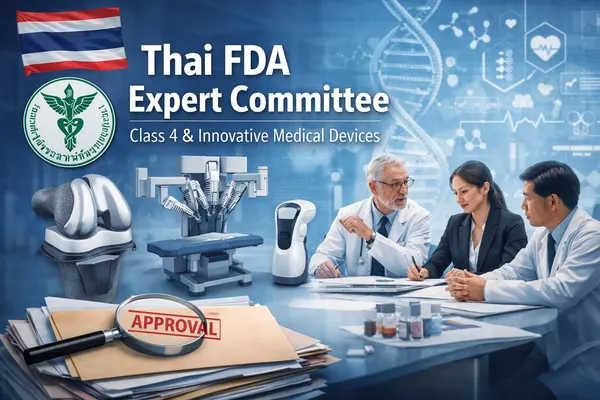
The increasing role of the Thai FDA Expert Committee is reshaping the regulatory pathway for high-risk and innovative medical devices in Thailand. For manufacturers seeking approval of Class 4 products or technologies not yet recognized in reference countries, understanding how this evaluation mechanism works is becoming a critical factor in planning timelines, costs, and overall market entry strategy.
A Structural Shift in Thai FDA Evaluation Approach
In recent years, the Thai FDA has progressively reinforced its evaluation framework for high-risk and innovative medical devices.
A clear trend is now emerging: devices classified as Class 4, or considered “innovative” and not previously approved in recognized reference countries, are increasingly routed through an Expert Committee review.
This is not an isolated procedural adjustment. It reflects a broader regulatory direction toward greater scrutiny, risk control, and scientific validation.
When Does the Expert Committee Apply?
The Expert Committee pathway is typically triggered when:
- The device is classified as Class 4 (highest risk)
- The product is novel or based on new technology
- There is no prior approval in reference countries, such as:
- United States
- European Union
- Japan
- Australia
- Canada
- Singapore
In these cases, the Thai FDA does not rely solely on dossier conformity. Instead, it escalates the evaluation to a panel of specialists.
What the Expert Committee Actually Does
The Expert Committee performs a deep technical and clinical assessment, which may include:
- Evaluation of clinical evidence and study design
- Analysis of risk-benefit profile
- Review of manufacturing and quality systems
- Requests for additional data or clarifications
Unlike standard pathways, this process is not purely administrative. It is scientific, interpretative, and discretionary.
Impact on Timelines
One of the most immediate consequences is a significant extension of approval timelines.
While a standard registration may follow predictable review windows, the Expert Committee pathway introduces:
- Scheduling dependencies (committee availability)
- Multiple review rounds
- Unpredictable response cycles
As a result, timelines can extend well beyond standard expectations, often becoming case-specific rather than procedural.
Impact on Costs
The involvement of the Expert Committee also leads to higher overall project costs, driven by:
- Additional regulatory preparation and strategy work
- Potential clinical data generation or adaptation
- Extended project management and follow-up activities
- Possible re-submissions or supplementary documentation
These costs are not arbitrary—they reflect the increased depth of evaluation required.
The fee for committee ranges between 38,000 and 53,000 THB. Your Consultant will of course apply additional fees for the follow up, that mostly require a couple of meetings in person.
Not a Barrier, but a Control Mechanism
It is important to clarify a common misconception:
this pathway is not a regulatory obstacle or discretionary “caprice.”
It is a deliberate control mechanism designed to:
- Ensure patient safety
- Validate high-risk technologies
- Align Thailand with global regulatory best practices
For genuinely innovative or high-risk products, this level of scrutiny is both expected and justified.
No Shortcuts Available
A critical point for manufacturers and distributors:
There are no shortcuts to bypass the Expert Committee when the criteria apply.
Attempts to:
- Reclassify the device artificially
- Minimize its innovative nature
- Submit incomplete or strategically weakened dossiers
are not only ineffective but may compromise the entire approval process.
Strategic Planning: Pros and Cons
A properly planned regulatory strategy can significantly influence outcomes.
Advantages of Proper Planning
- Anticipation of Expert Committee requirements
- Early preparation of clinical and technical evidence
- Reduced risk of major delays or rejections
Challenges
- Higher upfront investment
- Longer time-to-market
- Greater regulatory complexity
This creates a classic trade-off:
speed vs. robustness, cost vs. certainty.
Conclusion
The increasing use of the Expert Committee by the Thai FDA marks a maturation of the regulatory system, particularly for high-risk and innovative medical devices.
For companies entering the Thai market, the key is not to resist this process, but to understand it, anticipate it, and integrate it into a structured regulatory strategy.
In this context, success is no longer determined by documentation alone, but by the quality of preparation, the strength of evidence, and the ability to navigate a more sophisticated evaluation framework.

It’s impressive that you are getting thoughts from this article as well as from our argument
made at this place.
b5yawf
58m37f
iureue
ihn0yo
I visited many blogs but the audio feature for audio songs existing at this web page is in fact wonderful.
If you wish for to take a good deal from this piece of
writing then you have to apply these methods to your won website.
Wow, awesome blog structure! How long have you ever been blogging
for? you make blogging glance easy. The whole look of your website
is excellent, as neatly as the content!
Just started playing on ww7game, and I’m liking what I see. Graphics are slick, the gameplays’ smooth, and it’s easy enough to get the hang of. I recommended checking out ww7game