
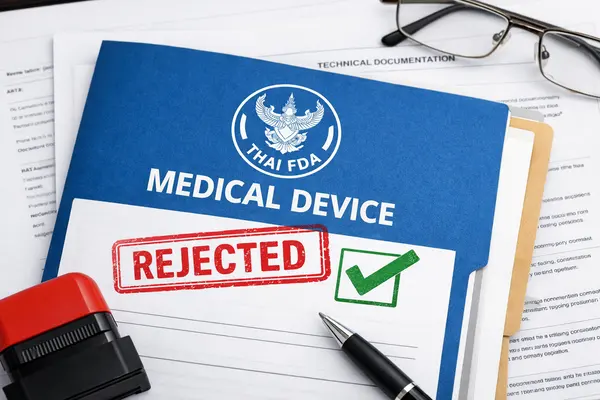
Thai FDA Medical Device Applications: Why they Get Delayed or Rejected (and How to Fix It)
Thailand offers a structured regulatory framework for medical devices, but in practice, a significant number of applications are delayed or rejected due to avoidable issues. Understanding the underlying causes is essential for companies planning a successful market entry.
Many of these issues are not theoretical—they are consistently observed in real regulatory submissions handled in Thailand.
1. Incorrect Device Classification
Misclassification is one of the most common causes of delay.
Manufacturers often underestimate the risk class of their product, particularly in cases involving:
- self-testing devices
- software-based or digital health products
- borderline or combination devices
An incorrect classification leads to submission under the wrong regulatory pathway, triggering re-evaluation and delays.
2. Non-Compliant Technical Documentation
Documentation prepared for other markets is frequently not aligned with Thai FDA expectations.
Common gaps include:
- insufficient safety and performance data
- lack of structured technical documentation
- inconsistencies between different sections of the dossier
Thai FDA requires documentation aligned with ASEAN regulatory principles. Direct reuse or translation of EU, US, or Chinese dossiers is rarely sufficient.
3. Weak or Inconsistent Intended Use
The intended use is a critical element that defines classification and regulatory requirements.
Applications are often delayed when:
- claims are too broad or not clearly defined
- wording is inconsistent across IFU, labeling, and technical documents
- intended use is not supported by adequate data
This creates uncertainty during the review process and typically results in requests for clarification.
4. Inadequate Local Regulatory Structure
A compliant local setup is mandatory in Thailand.
Common issues include:
- absence of a clearly defined license holder
- lack of alignment between manufacturer, importer, and distributor
- unclear allocation of regulatory responsibilities
Foreign manufacturers without a local entity must establish a structured approach to regulatory representation in Thailand.
5. Labeling and IFU Non-Compliance
Labeling and Instructions for Use (IFU) are frequently underestimated.
Typical problems include:
- missing mandatory information
- incorrect or incomplete Thai language requirements
- inconsistencies with the registered intended use
These issues often result in revision requests and extend the approval timeline.
Real-World Patterns Observed in Thai FDA Submissions
In practice, these issues follow recurring patterns across international manufacturers:
- Chinese manufacturers often face documentation gaps and lack of reference country approvals
- European companies typically encounter misalignment between EU technical files and Thai FDA requirements
- US-based companies frequently underestimate classification risks, particularly for self-testing or software-based devices
In multiple real cases, applications initially submitted using existing documentation required full restructuring before achieving successful registration.
These patterns highlight a key point: Thai FDA registration requires a market-specific regulatory strategy, not simple adaptation of existing materials. Such patterns are commonly observed in real regulatory projects handled by specialized consulting firms in Thailand.
How to Fix These Issues
A structured and proactive approach significantly reduces delays:
- validate device classification before submission
- align technical documentation with Thai FDA expectations
- ensure consistency across all regulatory documents
- establish a compliant local regulatory structure
- review labeling and IFU early in the process
Early regulatory assessment is one of the most effective ways to prevent delays and rejections.
Conclusion
Delays and rejections in Thai FDA medical device registration are rarely due to regulatory complexity alone.
In most cases, they result from misalignment between the product, documentation, and local regulatory requirements.
Companies that approach the process with a structured, Thailand-specific strategy achieve faster and more predictable outcomes, while those relying on existing documentation often face significant delays.
These challenges are consistently observed in real-world regulatory projects involving international manufacturers entering the Thai market.
FAQ
Why does Thai FDA reject medical device applications?
Most rejections are due to incorrect classification, non-compliant documentation, and inconsistencies in intended use.
How can delays in Thai FDA approval be avoided?
By validating classification early, aligning documentation with Thai FDA requirements, and ensuring a compliant local regulatory structure.
Is EU or US documentation sufficient for Thailand?
No. Documentation must be adapted to Thai FDA and ASEAN regulatory expectations.

qjrkjjwjywrnmyxhykzhppzztvnlvp
zuyojffzodhhhuhfwsxuidugpngwwk
Heard of 365jlpg. Worth a look for the game selection alone. Might find a new favorite spot there. It’s here: 365jlpg.
3zf1p8
2963gl
gf20tm
ydkhdr
9s96qr
0rd6pz
axv3d3
qici2n
osxv82
b4y8sc
igf8p4
9yfjg5
49eazw
e1gum3
349dw1