MDA–Thai FDA Medical Device Regulatory Reliance Programme: Full Implementation from 1 May 2026
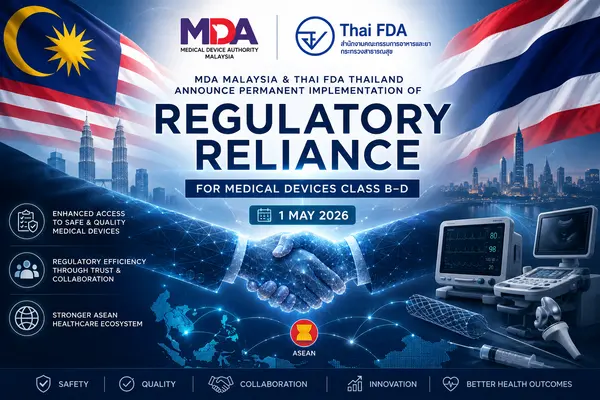
A landmark shift in ASEAN medical device regulation took effect on 1 May 2026, as the Medical Device Authority (MDA) of Malaysia and the Thai Food and Drug Administration (Thai FDA) of Thailand announced the full implementation of the MDA–Thai FDA Medical Device Regulatory Reliance Programme for the registration of Class B, C, and D medical devices. mda
For manufacturers and importers currently navigating the Thai FDA registration process, this development represents one of the most significant regulatory shortcuts available in the region today.
What is the MDA–Thai FDA Regulatory Reliance Programme?
MDA and Thai FDA signed a Confidentiality Agreement to deepen regulatory cooperation and officially launched a 3-month pilot of the Medical Device Regulatory Reliance Programme. The signing took place during the 29th GHWP Annual Meeting held in Bangkok, Thailand on 4 December 2025. mda
The programme applies the principle of Good Reliance Practices, meaning that one authority accepts and builds upon the regulatory review already completed by the other, rather than conducting a full independent evaluation from scratch. For Thailand specifically, the Thai FDA and MDA Malaysia pilot project aims to promote mutual recognition of medical device safety and performance assessments under Good Reliance Practices principles. moph
Key outcomes of the 3-month pilot phase (February–April 2026)
Following the successful completion of the three-month pilot phase from 1 February 2026 to 30 April 2026, MDA and Thai FDA confirmed that the reliance model significantly optimizes the registration process for Class B, C, and D medical devices by leveraging the regulatory reviews of a trusted partner. Both authorities were able to reduce regulatory duplication, accelerate market access, and improve patient access to quality healthcare technologies. mda
Industry participation during the pilot confirmed the model works in practice, providing a proof-of-concept that supported the decision to move to full implementation.
Who can apply: eligible device classes and conditions
Not all devices qualify. According to the Thai FDA’s official programme conditions, eligibility is limited to:
Medical devices of risk class 2 to 4, or Class B to D only. The device must have received registration approval from MDA Malaysia — excluding devices with specific notifications and devices exempted from quality, efficacy and safety evaluation, such as Class A or Exempted product approvals. The trade name, model, product code, intended use, indications, label, accompanying documents and packaging must be identical to those approved by MDA Malaysia. moph
Two registration routes under the programme
The programme creates a bilateral fast-track, operating in both directions.
Under the MDA Verification Route, any medical devices that have obtained Thai FDA approval can bypass the full evaluation route by utilizing the Verification Route, significantly streamlining the local registration process in Malaysia. Under the Thai FDA MDA–Thai FDA Reliance Programme route, any medical devices that have obtained MDA Malaysia approval can bypass the external expert evaluation with full CSDT submission, significantly streamlining the local registration process in Thailand. mda
In practical terms, for a device already registered with MDA Malaysia, the Thai FDA review is substantially simplified — removing the most time-consuming step of external expert evaluation.
Required documents: Full CSDT and MDA approval evidence
Documents required for submission under the pilot programme include the registration documentation in Full CSDT format, identical to the documents used for registration with MDA Malaysia, plus evidence of registration in Malaysia. moph
This means the documentation burden is not eliminated, but the evaluation burden is — manufacturers who have already prepared a complete CSDT for Malaysia can reuse it directly for Thailand.
What this means for medical device manufacturers entering Thailand
For companies with existing MDA Malaysia registration, this programme changes the Thailand market entry calculus considerably. What previously required a full independent review cycle — often 6 to 12 months for Class II devices — can now proceed along an abbreviated pathway that removes the external expert evaluation stage entirely.
This transition marks a permanent shift toward regulatory harmonization between Malaysia and Thailand, streamlining the market entry process for medical device manufacturers in both territories, according to the WHO Good Reliance Practices. mda
Contact Thai FDA and MDA for registration support
For questions on the Thai FDA side, the International Cooperation Group of the Medical Device Control Division can be reached at inter.mdcd@gmail.com or by phone at 02 590 7149. For MDA Malaysia registration queries, contact registration@mda.gov.my.
Sources: Thai FDA Medical Device Control Division — Malaysia MDA–Thai FDA Pilot Project page; Joint Announcement by MDA Malaysia and Thai FDA, 1 May 2026.
