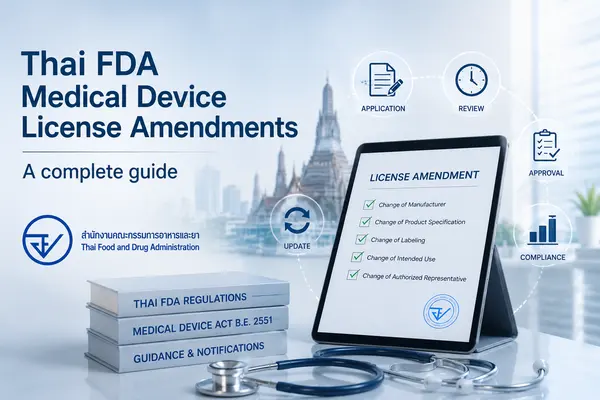
Thai FDA Medical Device License Amendments: Rules, Classes and How to Get Them Right
Getting a medical device registered in Thailand is a significant milestone. But registration is not the end of the regulatory story — it is, in many ways, the beginning. Products change. Manufacturers relocate. Labels get updated. Software is revised. Quality systems evolve. Every one of these changes may trigger an obligation to notify — or formally amend — your existing license with the Thai Food and Drug Administration (FDA).
This is where many companies, particularly those managing their regulatory affairs from outside Thailand, make costly errors. The assumption that a minor modification does not require any action is one of the most common — and most dangerous — misconceptions in medical device compliance. Under Thai FDA rules, even changes that appear cosmetic or purely administrative can invalidate a license if not handled through the correct amendment pathway.
Thailand’s medical device regulatory framework categorises post-market amendments into two broad types: those that are processed automatically without expert review (Auto-Approved), and those that require academic evaluation by external specialists or Thai FDA experts before approval can be granted. Which pathway applies to your change depends on your device class and the precise nature of the modification.
This guide walks through every amendment category recognised by the Thai FDA — across Class 1 (J.N. 3 and J.N. 4) and Class 2, 3 and 4 devices — and highlights the most common filing mistakes that result in delays, rejections, or licence invalidation.
The Two Types of Amendment: Auto-Approval vs Expert Review
Every post-market change to a registered medical device in Thailand falls into one of two tracks. Understanding which track applies is the starting point for any amendment process.
| Device Class | Auto-Approved Changes | Expert Review Required |
|---|---|---|
| Class 1 – J.N. 3 | Grouping reductions, product owner name (merger), manufacturer name/location (same site), ISO 13485 declaration updates | Adding devices to grouping, label/documentation changes, accessories, software additions |
| Class 1 – J.N. 4 | Import/manufacturing location changes, software modifications with no performance impact (GMD, AMD, IVD) | Manufacturing/QMS changes, labeling amendments, material/component specification changes, method of use |
| Class 2, 3, 4 | QMS scope changes (no device impact), import/manufacturing location, certification body, ISO 13485 update (same facility) | Manufacturing process, sterilization, design, labeling, materials, software, product listing corrections |
Class 1 Devices (J.N. 3): What Can Be Changed and How
Class 1 J.N. 3 devices are the lowest-risk category under Thai FDA classification. While the amendment process is comparatively straightforward, it is not without structure. Several change types still require academic review before they can be approved.
AUTO-APPROVED
- Reducing the number of registered devices within an existing grouping
- Product owner name change resulting from a corporate merger
- Name and location of the original manufacturer (product owner)
- Overseas manufacturer name or location change — only where the physical site remains the same
- Updated declaration of conformity, such as renewal of an ISO 13485 manufacturing quality certificate
EXPERT REVIEW REQUIRED
- Adding devices of the same design to an existing grouping
- Adding devices or software that do not affect performance characteristics or product specifications
- Adding accessories to the primary medical device
- Label or accompanying documentation changes that do not alter the intended use or indications
Class 1 Devices (J.N. 4): A More Complex Amendment Landscape
J.N. 4 devices sit within Class 1 but are subject to a broader and more nuanced set of amendment rules. The range of changes that trigger expert review is wider, and particular attention is required around labelling, materials, and manufacturing processes.
AUTO-APPROVED
- Changes to import or manufacturing location information where the registered establishment has changed
- Software modifications for GMD/AMD devices — exclusively where performance and safety are demonstrably unaffected
- Software modifications for IVD devices — exclusively where performance and safety are demonstrably unaffected
EXPERT REVIEW REQUIRED
- Manufacturing: Adding, removing, or changing overseas manufacturers while maintaining the original legal manufacturer or product owner; sterilization facility changes where the process and specific requirements remain unchanged
- Labelling: Adding or changing warnings, precautions, contraindications, or adverse events; reducing indications; revising text without changing the main idea; any change not affecting efficacy or safety
- Materials: Modifying non-biological material formulas, coatings, or coating techniques for devices in contact with body tissues or fluids, or intended for body absorption — provided performance specifications are not affected
- Product listing: Correcting typographical errors; changes where the product code identifies the same device
- Method of use: Any modification affecting performance, safety, or the intended user profile
Class 2, 3 and 4 Devices: High-Risk Changes Require Full Documentation
For medium- and high-risk medical devices, the Thai FDA applies the most rigorous amendment standards. Every amendment is subject to documentation requirements and case-by-case analysis. Many changes that would be auto-approved for Class 1 devices require full expert review at higher risk classes.
AUTO-APPROVED
- Reducing the number of registered devices within a category
- QMS certification scope changes that have no impact on registered devices
- Import or manufacturing location changes as specified on labelling and documentation
- Changing the QMS certification body without altering the certification scope
- Updating ISO 13485 certification to the current level at the same production facility
EXPERT REVIEW REQUIRED
Manufacturing Facility, Process or Quality Management System
- Modifications to manufacturing processes that affect device performance or safety
- Changes to sterilization methods or processes
- Adding, removing, or changing overseas manufacturers while maintaining the original legal manufacturer
- Sterilization facility changes where the process and specific requirements are maintained
- Alterations to the manufacturing process that do not affect effectiveness or safety
Product Listing
- Adding medical equipment or same-design devices to the registered list
- Adding devices or software that do not affect performance characteristics or product specifications
- Adding accessories to the primary device
- Correcting typographical errors in device or accessory listings
- Product code changes where the same device is maintained
- Product owner name or address changes without modifying the overseas manufacturer location
Labelling and Documentation
- Adding or changing indications for use
- Adding, removing, or revising contraindications, warnings, or precautions
- Reducing indications
- Method of use modifications affecting performance, safety, or the intended user
- Text changes that preserve the main idea of the original content
- Label changes that do not affect efficacy or safety
Design and Specifications
- Modifying control mechanisms, operating principles, design, specifications, or performance characteristics without changing the assay principle
- Design changes that do not affect performance or safety
Software (GMD/AMD and IVD)
- Modifications affecting performance, processing time, or processing specifications
- Software changes that do not affect performance or safety
- For IVD: changes affecting processing conditions and in vitro diagnostic analyzer specifications
Materials and Components
- Modifications to drug concentration or specifications of medicinal substances within medical devices
- Changes to shielding materials in ionizing radiation devices
- Non-biological material formula or coating changes for body-contact use — whether or not the new material comes from a different manufacturer, and regardless of whether body contact characteristics differ from the original
- Changes to the type, source, process, or supplier of biological materials without altering their intended purpose
- Amendments to supplier lists for non-biological materials (excluding medicinal substances and biological materials) without affecting performance specifications
- For IVD: modifications to key chemical or biological components that affect performance specifications but not design specifications; supplier list amendments for non-biological materials
Common Mistakes When Filing Amendments in Thailand
Based on regulatory practice across hundreds of medical device submissions in Thailand, the following errors appear repeatedly — and each carries real consequences.
When to Call a Regulatory Specialist
Not every amendment requires external support. Straightforward Auto-Approved changes — a manufacturer address update, a certification renewal — can often be handled internally by a competent regulatory team with experience in Thai FDA processes.
However, specialist input becomes important in several scenarios: when the nature of the change sits close to the boundary between amendment categories; when multiple changes are being made simultaneously and their combined regulatory impact is unclear; when the change involves biological materials, sterilization processes, or clinical indications; or when the device is Class 3 or Class 4 and the consequences of a misstep are severe.
Thailand’s regulatory environment for medical devices has matured considerably in recent years, and the Thai FDA’s enforcement posture has become more active. Companies that treated the post-market phase as an administrative afterthought a decade ago are finding that approach increasingly untenable. The amendment rules exist to protect patients — and regulators expect them to be followed with the same rigour as the initial registration process.
If you are uncertain about whether a change to your registered device requires an amendment, the safest answer is almost always: yes, it does. The cost of a proper filing is a fraction of the cost of a compliance failure.
