Announcement of the FDA Regarding the Criteria, Procedures, and Conditions for Registration of Medical Device Manufacturing Facilities (2026)
A seemingly “ordinary” title, but a regulatory shift
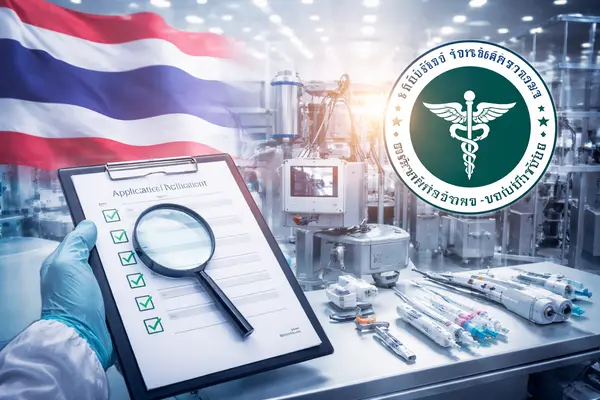
On 15 January 2026, the Thai Food and Drug Administration (Thai FDA) issued a new Announcement on the Criteria, Procedures, and Conditions for Registration of Medical Device Manufacturing Facilities, published in the Royal Gazette on 2 March 2026 and effective from May 2026. At first glance, the document may appear to be a routine update of forms required for Medical Device Manufacturing License applications. However, for professionals who follow daily operations in the FDA departments, the implications are substantial and structural.
The announcement fundamentally changes how the Thai FDA evaluates and grants licenses to medical device manufacturing facilities, shifting the focus from a simple document checklist to alignment between the facility’s operations, its technical capabilities, and the risk class of the products handled.
1. Differentiation at the initial screening: type of operation
One of the main changes introduced by the new Announcement concerns the first screening based on the type of operation (rather than simply the license category):
- Manufacturing: full device production process.
- Assembly: assembly of finished components.
- Repacking: repackaging or reassembly without technical modification.
- Sterilization: final sterilization process for devices requiring this treatment.
This categorization ensures that each facility is explicitly authorized for the specific operations it performs, reducing the ambiguities that previously arose when generic “manufacturing” claims did not reflect actual use.
Practically, the Thai FDA now expects SOPs tailored to the activity performed: if the facility assembles devices, SOPs must describe assembly processes; if sterilizing, SOPs must detail sterilization and quality control. This approach minimizes the risk of objections or requests for additional documentation during inspections.
2. Alignment between facility and product risk class
Another key change is how the FDA now links the facility to the risk classification of the products. Previously, evaluations focused primarily on the finished product and its risk class for registration purposes.
Under the new framework, the assessment considers:
- the risk class of the devices handled by the facility,
- the technical capabilities and infrastructure of the facility,
- the quality and appropriateness of documented processes.
This means that a facility producing high-risk devices (Class 3 or Class 4) will face higher operational and quality management requirements than one performing low-risk assembly or repacking.
In practice, this translates to:
- SOPs specific to the operation and product risk,
- facility layouts and equipment appropriate to the declared activity,
- process and quality control records aligned with product risk.
This structure eliminates grey areas where declared operations did not match actual practices—a common cause of inspection delays or deficiencies.
3. Transition for already licensed facilities
It is important to note that facilities already holding a license will continue to operate under the previous rules. However:
- Upon license renewal,
- When modifying the declared operations,
- Or during a scheduled FDA inspection,
the facility must comply with the new criteria, procedures, and conditions, including SOPs that reflect the actual activity and quality control measures proportional to the risk of the products handled.
Practical implications for operators
This Announcement is not a mere formal update. It represents a rationalization of facility evaluation, combining:
- the actual operations performed,
- the technical capabilities of the facility,
- alignment with the risk classification of medical devices handled.
In essence, the Thai FDA is moving toward a more integrated and qualitative assessment, consistent with international best practices in quality management and GMP compliance.

qb4i5w
Golo789gamedownload, downloading games ain’t always my jam, but this was fairly painless. Once installed, experience was pretty good overall. See for yourself: golo789gamedownload
oy5m88
mfv73a
ny3q2a
gdc4cl
c571n5
EE88, cái tên nghe quen quen, hình như có thằng bạn hay chơi ở đây thì phải. Thấy nó bảo nạp rút nhanh lắm. Ai confirm cái nào! Get the scoop here: ee88.
Heard about thmn9 from a buddy – legit site! Easy to navigate and got some good wins early on. Definitely worth checking out for a fun time. thmn9
aspz5a
t9c8sc