Medical Device Grouping Criteria Under Thai FDA Regulations
When applying for medical device registration in Thailand, one of the most important preliminary assessments concerns how products may be grouped under a single license.
The Thai FDA does not automatically accept grouping requests submitted by applicants. The final determination regarding grouping structure rests exclusively with the authority, based on the official criteria issued on 26 October 2018 regarding medical device group classification.
Understanding these grouping rules is essential to optimize regulatory strategy, reduce licensing costs, and avoid delays.
Why Medical Device Grouping Matters
In Thailand, multiple products may be registered under one license if they fall within specific grouping categories. Proper grouping can:
- Reduce the number of licenses required
- Simplify post-market management
- Streamline amendments and renewals
- Optimize regulatory costs
However, grouping is only permitted if strict criteria are satisfied.
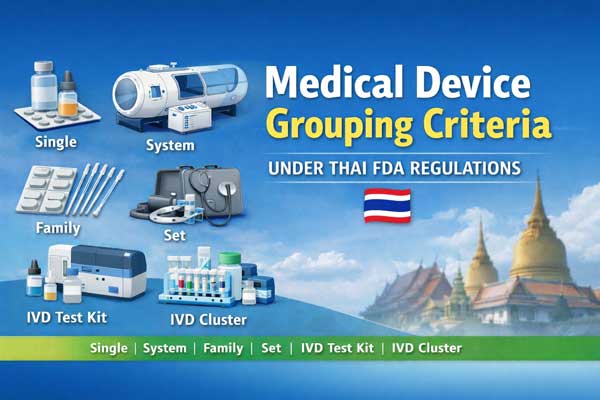
Thai FDA recognizes six main grouping models:
- Single
- System
- Family
- Set
- IVD Test Kit
- IVD Cluster
Each category follows different technical requirements.
1. Single Medical Device (SINGLE)
A Single device refers to one proprietary product name or brand with a clearly defined intended use.
Permitted variations may include:
- Different sizes
- Packaging formats
- Minor aesthetic differences
Example: A condom marketed under one brand name but available in different sizes and colors.
2. System (SYSTEM)
A System consists of multiple components intended to operate together to achieve a common medical purpose.
To qualify as a System:
- Components may be manufactured by different entities
- All products must share the same Marketing Authorization Holder
- All components must function together for the declared intended use
- Labeling must clearly state that the components are intended to be used as a system
Example: A hyperbaric chamber supplied together with its compressor.
3. Family (FAMILY)
The Family model is one of the most frequently used grouping strategies.
Devices may be grouped as a Family if they:
- Are under the same product owner
- Share the same risk classification
- Have identical intended use
- Follow similar design and manufacturing processes
Example: Sterile swabs under the same brand but available in various sizes.
Permissible variants within a Family are strictly defined (see section below).
4. Set (SET)
A Set consists of two or more medical devices packaged together for a common intended purpose.
Key conditions:
- Sold under one proprietary or brand name
- Intended to be used together
- Same risk classification level
- Packaged in the same commercial unit
Individual components may have different manufacturing origins.
5. IVD Test Kit
An IVD Test Kit includes reagents and materials intended for in vitro diagnostic testing.
To qualify:
- Same product owner (Marketing Authorization Holder)
- Components work together to achieve one diagnostic objective
- Labeling must explicitly state “IVD TEST KIT”
- Sold as a unified diagnostic solution
6. IVD Cluster
An IVD Cluster refers to grouped reagents sharing:
- Same manufacturer
- Risk classification Type 1 or Type 2
- Same testing methodology
- Same diagnostic cluster category
An IVD Cluster may include analyzers specifically designed for use with the clustered reagents.
Permissible Variants Under the FAMILY Model
Thai FDA allows specific controlled variations within a Family registration, including:
- Color
- Dimensions (length, width, diameter, gauge)
- Shape and volume
- Sterility status (sterile vs non-sterile)
- Method of sterilization
- Lubrication coating material
- Mounting configuration (ceiling, wall, standing)
- Radiopacity
- Flexibility
- Memory storage capacity
- Printing capability
- Holding force
- Isotope activity level
- Viscosity (when related solely to concentration changes)
- Concentration differences with same indication and mechanism
- Pediatric vs adult dimensional differences
Any variation outside this predefined scope may require separate registration.
Strategic Considerations Before Filing
Before submitting an application to Thai FDA, manufacturers should:
- Map product portfolio
- Identify grouping eligibility
- Confirm risk classification alignment
- Verify ownership structure
- Review labeling compliance
Improper grouping can result in rejection, reclassification, or regulatory delay.
Final Considerations
Thai FDA allows multiple medical devices to be registered under a single license when grouping criteria are satisfied. However, grouping decisions remain at the sole discretion of the authority.
A structured regulatory assessment prior to submission is strongly recommended to optimize compliance and cost efficiency.
For professional guidance on Thai FDA medical device registration and grouping strategy, specialized regulatory support is advised.
