
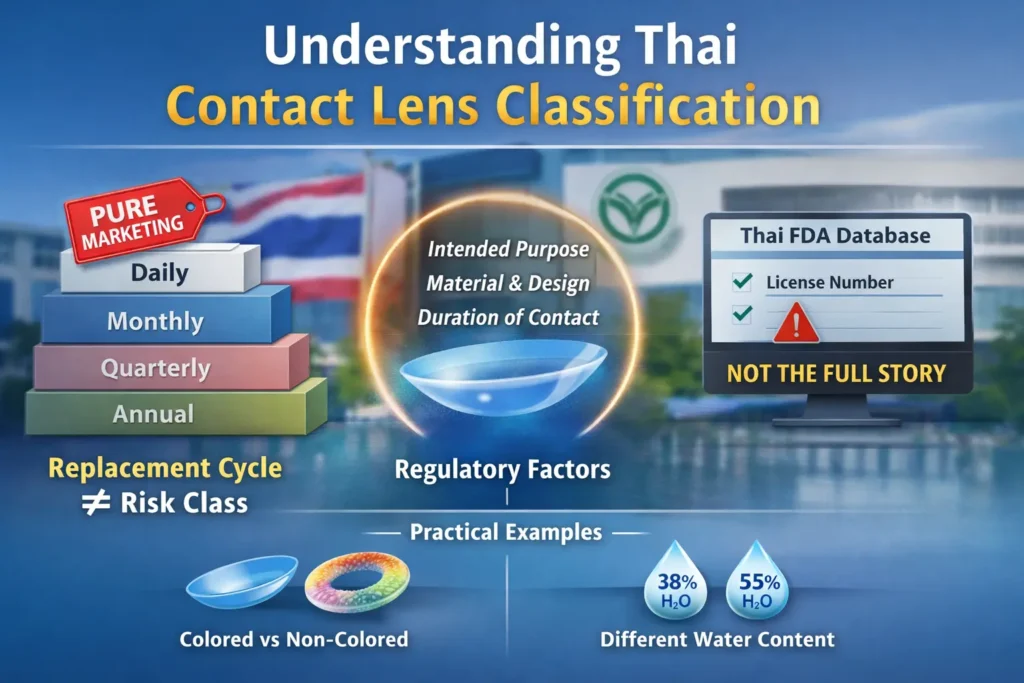
Contact Lens Classification in Thailand: What Really Determines Risk Class
Contact lenses are among the most misunderstood medical devices from a regulatory perspective.
A large part of this confusion originates from the way contact lenses are marketed: daily, monthly, quarterly, semi‑annual, annual, disposable, extended wear, cosmetic, colored, etc.
From a Thai FDA regulatory standpoint, these commercial categories are not risk drivers.
Replacement cycle is a marketing concept. It does not define medical device classification.
Understanding this principle is essential to avoid incorrect assumptions about risk class and registration strategy in Thailand.
How Thai FDA Classifies Contact Lenses
Thailand follows ASEAN medical device classification principles. Classification is driven by:
- Intended purpose
- Nature of contact with the body
- Duration of contact (short-term, long-term, continuous)
- Degree of invasiveness
Not by how often the lens is replaced.
Rule 5 and Contact Lens Classification Thailand
Soft contact lenses (hydrogel and silicone hydrogel) intended for vision correction and daily wear are generally classified as:
Class 2 medical devices under Rule 5
This applies regardless of whether the lenses are marketed as:
- Daily disposable
- Monthly disposable
- Quarterly disposable
- Semi‑annual disposable
- Annual disposable
As long as the intended purpose and mode of use remain the same, the replacement cycle does not change the risk class.
Why Replacement Cycle Is Pure Marketing
Replacement cycles are commercial positioning tools used by manufacturers to differentiate product lines and pricing tiers.
From a regulatory perspective, they do not represent different medical risks by themselves.
Two lenses that:
- Are made of the same material
- Have the same design
- Have the same intended purpose
- Are used in the same anatomical site
Do not become different risk classes simply because one is labeled “monthly” and the other “annual”.
This marketing‑driven structure is one of the main reasons why contact lenses are a challenging product category in regulatory practice.
Certificate Grouping: What Thai FDA Actually Evaluates
Thai FDA does not group products based on commercial variants.
Grouping under the same certificate is determined by:
- Same intended purpose
- Same material category
- Same design and technological characteristics
- Same manufacturing process
If products differ only in replacement cycle, they can normally be registered under one certificate.
The number of certificates depends on how many distinct technological families exist, not on how many marketing versions are sold.
Practical Examples of When Separation Is Required
Contact lenses are typically separated into different certificates when the difference represents a real material or compositional change, for example:
Colored vs Non‑Colored Lenses
- Colored lenses contain pigments
- Non‑colored lenses do not
Because the ingredient profile is different, separation is usually required.
Different Water Content Percentages
Example:
- Lens A: 38% water content
- Lens B: 55% water content
Different water content indicates a different material formulation.
In these cases, Thai FDA normally considers the products as different technological families, requiring separate certificates.
Why the Thai FDA Database Should Not Be Used for Classification Decisions
The public Thai FDA medical device database shows licensed products and license numbers.
It does not show:
- Regulatory review history
- Objections raised by officers
- Justifications for up‑classification
- Technical discussions during assessment
In Thailand, it is common for officers to request a higher class during review based on technical elements identified in the dossier.
These reasons are never visible in the database.
Therefore, the database may be useful for preliminary checks, but it must never be used as the basis for classification strategy.
System Entry vs Final Classification
When submitting soft contact lenses in Thailand:
- The online system typically forces selection of Class 2 under Rule 5
- Thai FDA officers can still request reclassification during technical review
Final contact lens classification Thailand is determined by the authority after dossier assessment.
Key Takeaways
- Replacement cycle is a marketing concept, not a regulatory criterion
- Soft contact lenses are generally Class 2 under Rule 5
- Grouping is based on technological families, not marketing variants
- Database data does not explain regulatory history
- Classification must be determined by regulatory analysis, not competitor listings
